
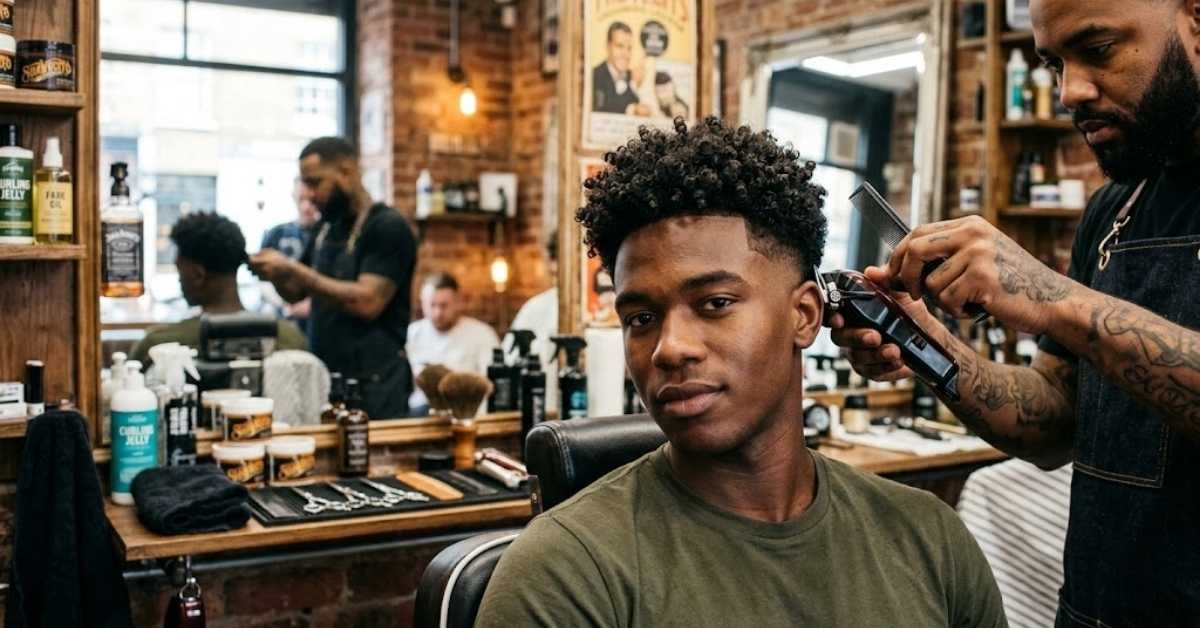

A taper fade for curly hair cleans up the sides and neckline while leaving the natural curls, coils, or waves on top. It gives curly hair a defined shape without taking away the texture that makes it stand out.
The best version depends on your curl pattern, face shape, top length, and how much contrast you want. A low taper looks subtle, a mid taper creates balanced definition, and a high taper gives the strongest contrast.
You can also pair curly taper fades with fringes, line ups, afros, mullets, beards, or longer textured tops. The key is to choose a taper that works with your natural curl behavior rather than forcing your hair into a shape it does not naturally hold.
What Is a Taper Fade for Curly Hair?
A taper fade for curly hair gradually reduces the hair around the temples, sideburns, and neckline while keeping more length toward the top.
Unlike a haircut that removes most of the side volume, a taper can preserve more of your natural shape. This makes it especially useful for curly and coily hair, where removing too much hair can change the overall silhouette.
Your barber can also choose how short the taper becomes. It can finish at a short guard length, a shadowed finish, or very close to the skin.
Taper vs. Fade for Curly Hair
A taper usually focuses on smaller areas around the temples, sideburns, and neckline. A traditional fade can extend farther up the sides and back.
For curly hair, this distinction matters because the amount of side volume changes the shape of the curls.
A taper is generally more subtle, while a higher fade creates stronger contrast. Modern barbering also allows these terms to overlap, so showing a reference photo is often more reliable than using the name alone. GQ similarly emphasizes that fade placement, texture, face shape, and personal style all affect the finished haircut.
Why Curly Hair and Taper Fades Work So Well Together
Curly hair already has texture and volume.
The taper provides structure around it.
That combination creates contrast without requiring you to straighten or heavily manipulate your curls. Shorter sides can make the curls on top appear fuller and more defined.
The haircut is also flexible. You can wear your curls natural, defined, messy, pushed forward, or shaped into a rounded afro.
For tighter curl patterns, the barber can preserve enough density on top to maintain the natural coil formation. Modern curly hair advice increasingly focuses on working with natural texture instead of fighting it.
Best Types of Taper Fade for Curly Hair
Low Taper Fade For Curly Hair
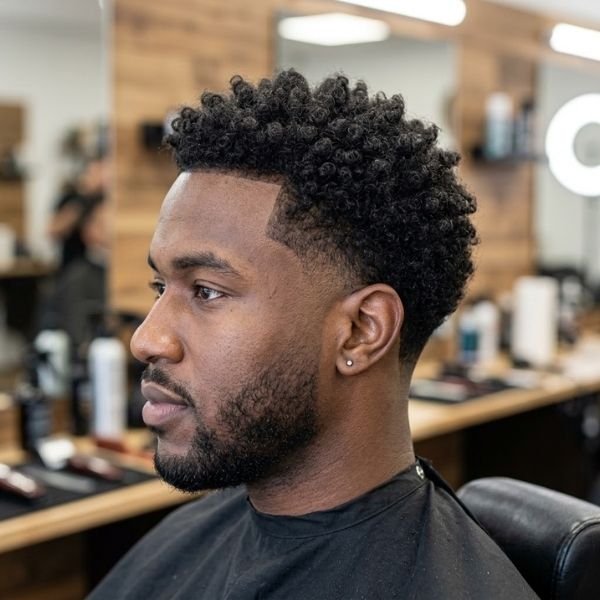
A low taper starts close to the ears and neckline.
It keeps more side fullness, making it a good choice if you want a natural appearance or do not want a dramatic change. It also works well with longer curls, fringes, and rounded shapes.
Read More: Taper Fade vs Low Fade: The Ultimate Guide to a Perfect Cut
Mid Taper Fade For Curly Hair
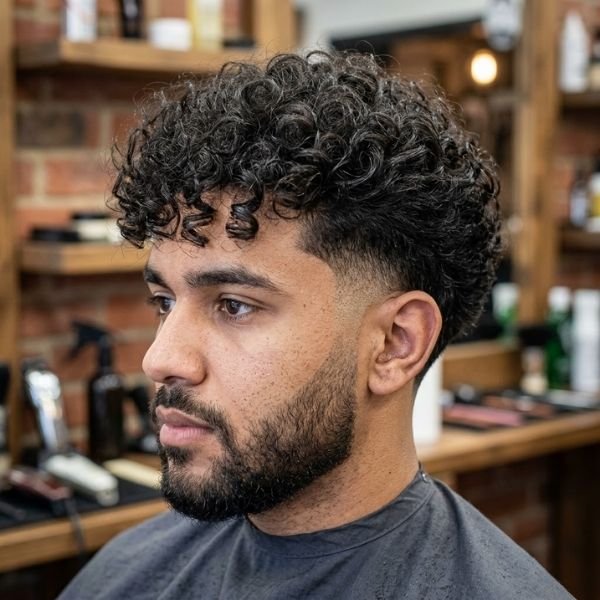
A mid taper removes more weight around the temples and creates a balanced transition into the curly top.
It works especially well when thick curls become too wide around the sides but you still want plenty of texture.
High Taper Fade For Curly Hair
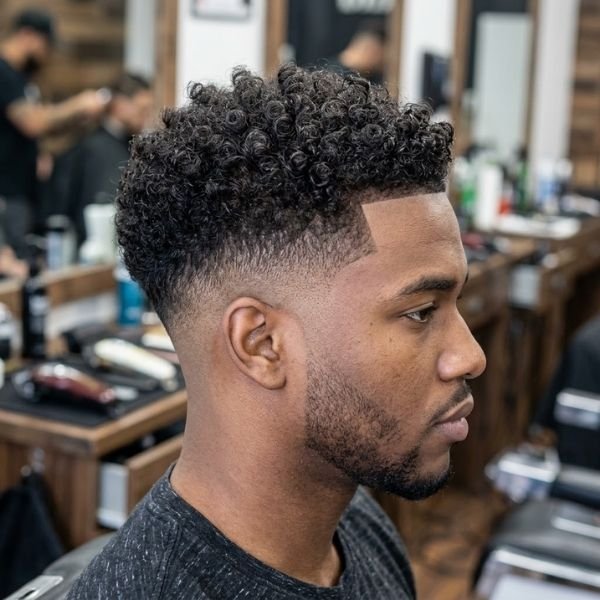
A high taper begins farther up the sides and creates noticeably stronger contrast.
It suits people who want the curls to become the main visual focus. The higher placement can also create the appearance of extra height when the curls are styled upward.
Other Fade Variations for Curly Hair
Drop Fade for Curly Hair
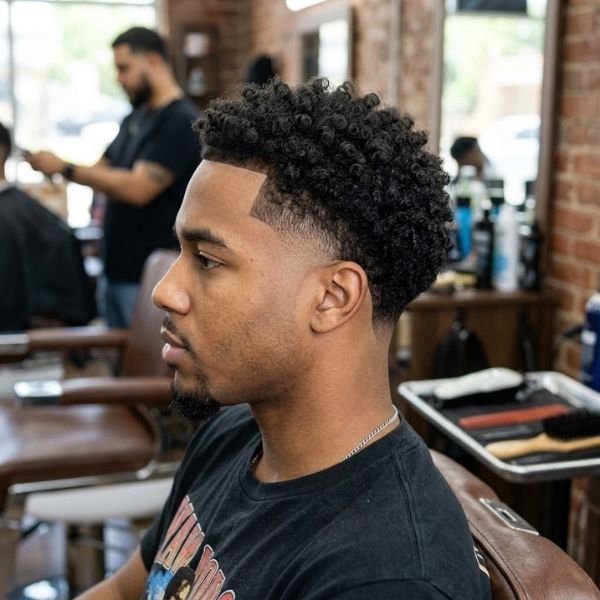
A drop fade follows the shape of the head and drops lower toward the back.
It can create a rounded, sculpted appearance while keeping the curly top prominent.
Burst Fade with Curly Hair
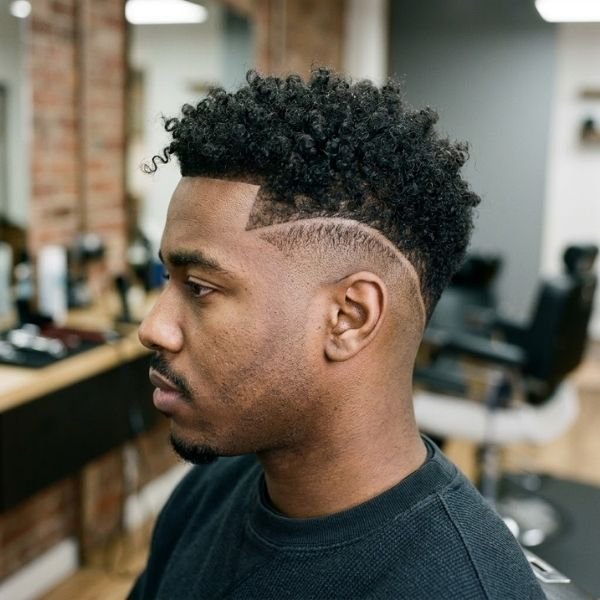
A burst fade curves around the ear rather than following a straight horizontal path.
It works particularly well with curly mohawks, textured tops, and curly mullets. The style also remains relevant in current men’s grooming because burst fades naturally accommodate textured hair.
25 Best Taper Fade for Curly Hair Styles
Curly Afro Taper Fade
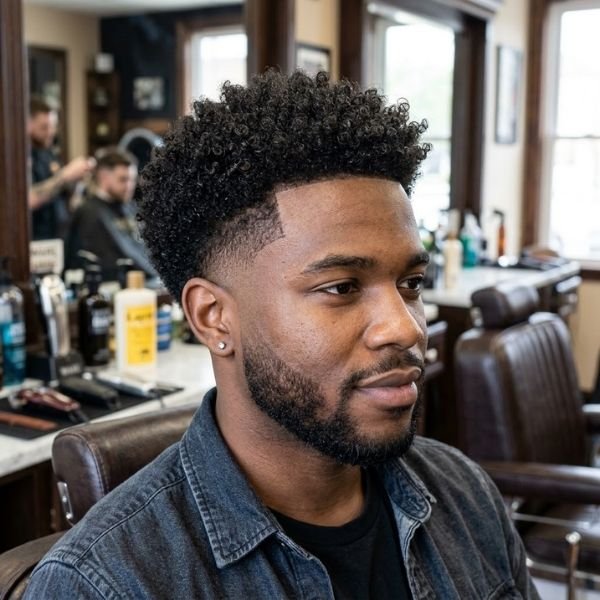
Keep the top full and rounded while tapering the temples and neckline. This combination preserves natural volume and gives the afro a cleaner outline.
Curly Fringe Taper Fade
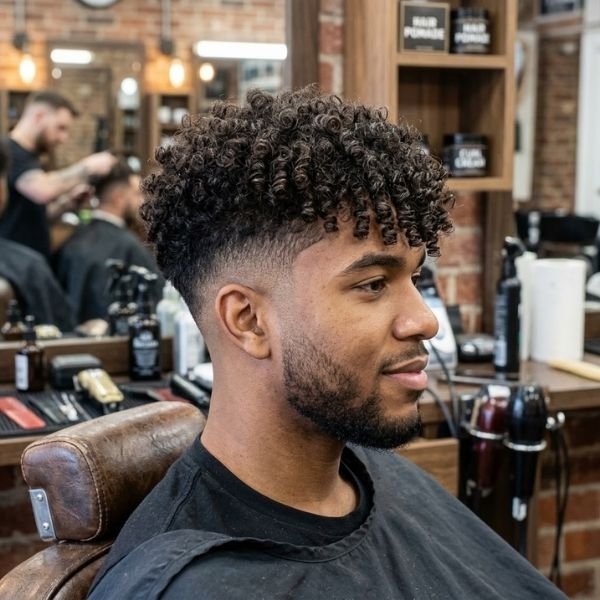
Leave extra length toward the forehead so the curls fall naturally forward. The tapered sides keep the fringe from looking overly bulky.
Defined Curls Taper Fade
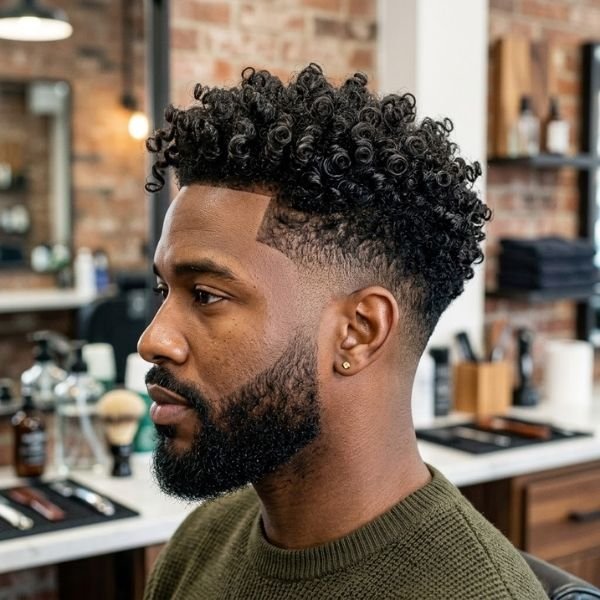
Use curl cream or leave in conditioner to separate individual curls. The clean taper makes the definition on top stand out.
Messy Curls Taper Fade
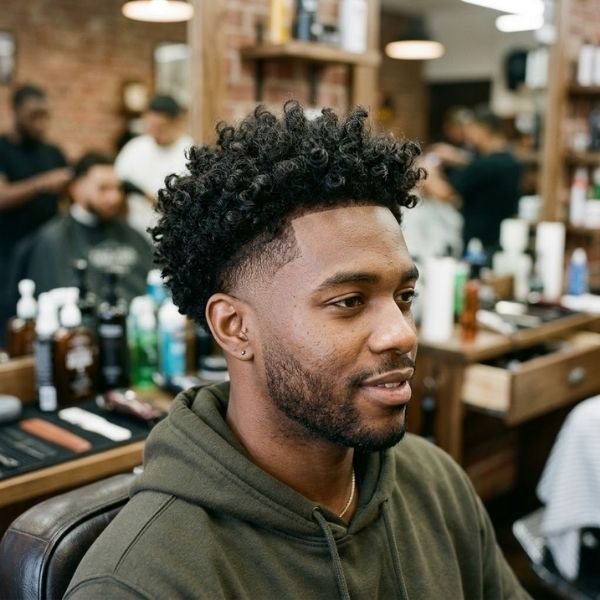
Keep the top textured and slightly loose instead of creating perfectly separated curls. This is a relaxed option that needs relatively little styling.
Curly Hair with Temp Fade
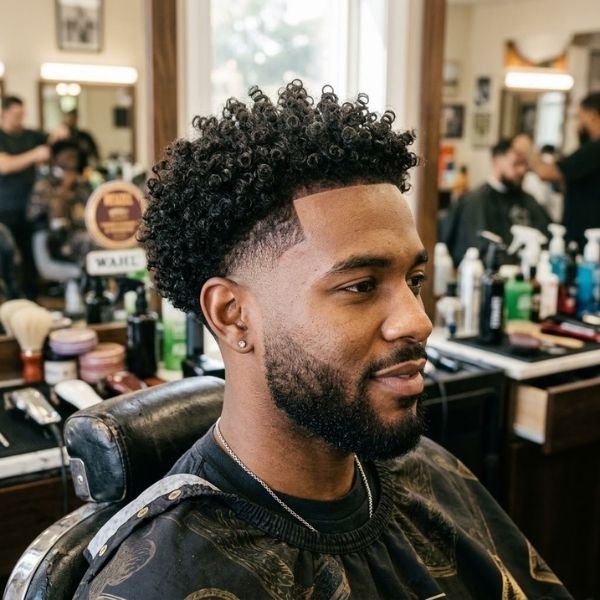
A temple fade focuses on the area around the temples and sideburns. It works well when you want subtle cleanup without removing much of the side volume.
Short Curly Taper Fade
Keep the curls short enough to remain easy to manage while maintaining visible texture. This is a practical option for an active lifestyle.
Curly Taper Fade with Line Up
A sharp line up creates definition along the forehead and temples. Ask your barber to preserve your natural hairline rather than pushing it too far back.
Read More: Mid Taper Fade Afro: 25 Best Styles, Tips, and a Full Tutorial
Curly Taper Fade with Long Hair on Top
Leave several inches of length on top for larger curls and more styling options. A softer taper prevents the contrast from becoming too severe.
Curly Taper Fade Mullet
Keep length through the back while tapering the temples and neckline. The result combines curly texture with the distinctive shape of a modern mullet.
Curly Taper Fade with Beard
Connect the haircut and beard through the sideburn area for a unified appearance. Your barber can taper the transition so the beard does not look disconnected.
2C Wavy Taper Fade
Type 2C hair sits between strong waves and loose curls. A low or mid taper can remove excess bulk while keeping the natural wave pattern visible.
3A Curly Taper Fade
Large, loose curls work especially well with a moderate amount of length on top. Use lightweight products so the curls remain bouncy.
3B Curly Taper Fade
3B curls have more defined ringlets and usually benefit from a clean taper around the sides. Keep enough length to prevent the top from looking too short after shrinkage.
3C Curly Taper Fade
Tighter 3C curls create strong texture and volume. A mid taper can provide structure while allowing the curls to remain the main feature.
4A Coily Taper Fade
4A hair forms tight, defined coils. Keep the top shaped according to its natural pattern and use the taper to clean the perimeter.
4B Coily Taper Fade
4B hair has a tighter, less uniform pattern. A skilled barber should account for shrinkage and density instead of judging the desired shape only from stretched hair.
4C Curly Taper Fade
A 4C taper can keep the top short and sculpted or leave it fuller for an afro inspired look. Moisture and careful shaping are especially important because tightly coiled hair can be prone to dryness and breakage.
Curly Taper Fade with Fringe
This version keeps a longer front section that naturally falls toward the forehead. It is ideal if you want your curls to frame your face.
Curly Taper Fade with Design
Add a simple shaved line or geometric detail to the tapered section. Simple designs usually remain recognizable longer than highly detailed patterns.
Natural Curly Taper Fade
Let your natural curl pattern determine the top shape instead of forcing a specific finish. This is one of the easiest options for people who prefer low styling effort.
Low Taper Fade with Curly Hair
Keep the taper close to the ears and neckline while leaving the sides relatively full. It gives curly hair a clean appearance without dramatically changing its shape.
Mid Taper Fade with Curly Hair
A mid taper balances side cleanup with natural curl volume. It is a useful middle ground if you cannot decide between a subtle and dramatic taper.
High Taper Fade with Curly Hair
Use a higher taper when you want maximum contrast between the short sides and curly top. It works particularly well with tall curls, coils, and textured shapes.
Curly Taper Fade with Long Fringe
Keep the front longer so the curls can hang naturally over the forehead. The taper creates structure while the long fringe provides movement.
Curly Taper Fade with Textured Top
Leave uneven natural texture through the top instead of creating uniform curls. A lightweight styling cream can enhance separation without making the hair stiff.
Taper Fade Curly Hair by Curl Pattern
Wavy Hair (Type 2)
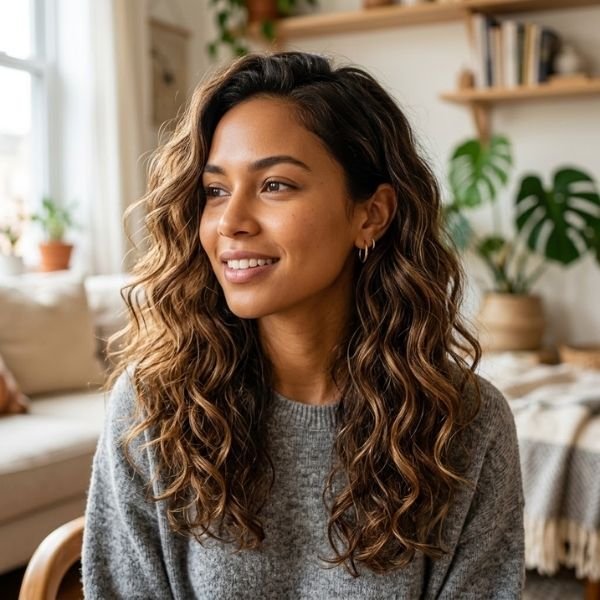
For 2C waves, a low or mid taper usually preserves enough side length to maintain the natural wave pattern.
Loose Curls (Type 3a and 3b)
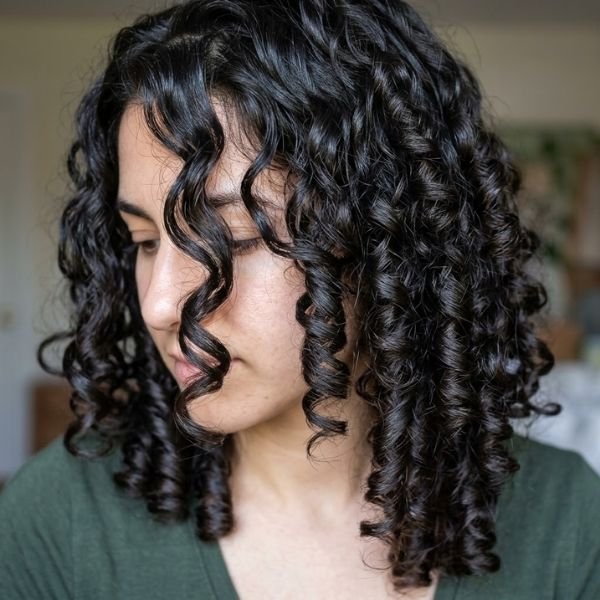
Loose curls benefit from enough top length to form complete curl groups. Avoid removing too much length simply to make the haircut look shorter.
Tight Curls (Type 3c and 4a)

Tighter curls can create significant volume and shrinkage. Your barber should consider how the hair looks naturally rather than relying only on stretched measurements.
Coily and Kinky Hair (Type 4b and 4c)
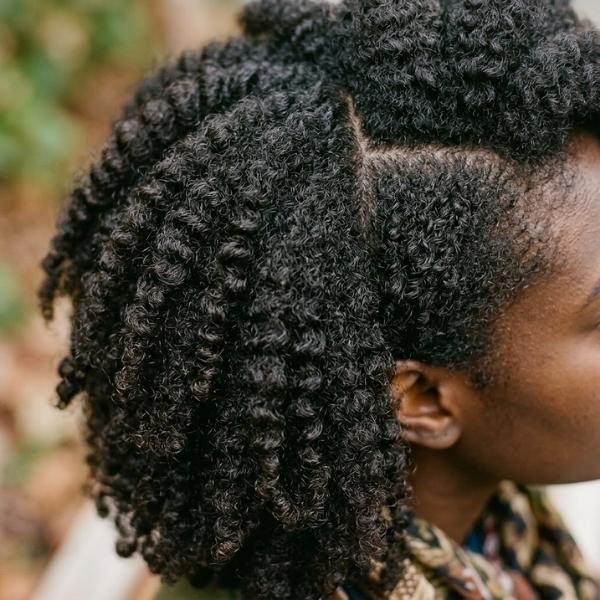
Type 4 hair can support sharp tapers, rounded afros, sculpted tops, and creative designs. Moisture, gentle detangling, and a barber familiar with textured hair can make a major difference.
How to Choose a Taper Fade for Your Face Shape
Oval Face
Most taper heights can work because the face is naturally balanced. Choose based mainly on your curl volume and preferred level of contrast.
Round Face
Consider keeping more height on top and avoiding excessive side width. A structured taper can help create a taller overall silhouette.
Square Face
A mid taper can complement a strong jaw while the curls soften the overall appearance.
Oblong or Long Face
A lower taper with moderate top height can help avoid making the face appear even longer. Keeping some side fullness may create better visual balance.
Heart Shaped Face
A moderate taper with textured volume can balance a narrower chin and wider upper face.
Diamond Face
Keep enough texture around the upper sides to complement prominent cheekbones. A moderate taper can provide structure without making the sides look excessively narrow.
Quick Tip
Face shape is only one factor.
Your curl density, hairline, head shape, top length, and daily styling routine can matter just as much.
How to Ask Your Barber for a Taper Fade For Curly Hair
1. Tell Your Barber the Taper Height
Say whether you want a low, mid, or high taper.
2. Explain How Much Length You Want on Top
Tell your barber whether you want short curls, medium curls, or several inches of length.
3. Show a Reference Photo
A photo communicates taper placement, curl length, shape, and neckline more clearly than a haircut name alone.
4. Explain How You Want Your Curls Styled
Mention whether you want natural curls, defined curls, a fringe, volume, or a messy finish.
5. Ask About the Hairline and Neckline
Decide whether you want a natural neckline, a sharper finish, or a softer taper.
6. Ask How Your Hair Should Be Cut
For curly hair, ask how the barber plans to account for shrinkage and your natural curl formation.
Read More: Low Taper Fade Short Hair: Best Styles to Try & Mistakes to Avoid
Simple Barber Request
You can say:
“Keep my curls natural and full on top. Give me a mid taper around the temples, sideburns, and neckline. Keep the blend clean, preserve my natural hairline, and do not remove more length from the top than necessary.”
How a Taper Fade for Curly Hair Is Cut
1. Assess the Curl Pattern
The barber examines density, curl direction, shrinkage, hairline, and the way your hair naturally sits.
2. Establish the Taper Area
The barber determines how high the taper should reach around the temples and neckline.
3. Gradually Blend the Sides
Different clipper lengths are blended to create a smooth transition without an obvious line.
4. Shape the Curly Top
The top is trimmed and shaped according to the desired silhouette. With curls, the final shape should account for how the hair springs back after drying.
5. Clean the Edges
The barber refines the temples, sideburns, forehead, and neckline.
6. Check the Finished Shape
The haircut should be checked from the front, sides, and back. Curly hair can change significantly as it dries, so the final silhouette matters more than a perfectly even stretched measurement.
Can You Do a Curly Taper Fade at Home?
You can maintain a taper between appointments, but creating a clean professional blend is difficult without experience. Curly hair also makes uneven transitions more noticeable.
For a first taper, a professional barber is the safer choice.
How to Maintain a Taper Fade with Curly Hair
Keep the Taper Fresh
A taper generally needs more frequent edge cleanup than the curly top. Your preferred frequency depends on how quickly your hair grows and how sharp you want the perimeter.
Wash and Condition Your Curls
Curly hair can become dry when washed too aggressively. The American Academy of Dermatology recommends washing textured hair according to its needs and conditioning curly hair throughout its length.
Moisturize After Washing
A leave in conditioner or suitable moisturizing product can help reduce dryness and make curls easier to style.
Dry Your Hair Gently
Do not aggressively rub curls with a towel. Gently squeeze or wrap the hair to remove excess moisture.
Protect Your Curls While Sleeping
A satin or silk covering can reduce friction. You can also use a loose pineapple or similar method when appropriate for your hair length.
Avoid Over Manipulating Curly Hair
Repeated touching, brushing, and reshaping can break up curl groups and increase frizz. The AAD recommends minimizing unnecessary brushing and using suitable detangling methods for textured hair.
Know When Your Hair Needs a Trim
If the taper loses its shape or the sides become bulky, it is probably time for a refresh. The exact schedule depends on growth rate and how precise you want the haircut to remain.
Best Products for Curly Hair Taper Fades
Curl Defining Cream
Useful for enhancing curl shape while keeping the hair soft and flexible.
Leave In Conditioner
Helpful when curls need extra moisture, softness, and easier detangling. Dermatologists note that curly hair can benefit from leave in conditioners designed for its specific needs.
Lightweight Styling Gel
Choose a lightweight gel when you want stronger definition and longer lasting hold.
Lightweight Hair Oil
A small amount can help reduce a dry appearance, but avoid applying too much because heavy buildup can flatten finer curls.
Clarifying Shampoo
Use occasionally when styling products create buildup. The AAD notes that people who regularly use gels, oils, creams, or pomades may benefit from clarifying shampoo before a moisturizing shampoo.
How to Choose Products for Your Curl Type
Fine curls usually need lightweight products.
Thick curls often tolerate richer conditioning products.
Tight coils may need more moisture and careful detangling.
Start with a small amount and add more only when necessary. More product does not automatically mean better definition.
Trending Taper Fade Curly Hair Styles Right Now
Natural Texture and Defined Curls
Natural curl definition remains a strong direction because it highlights texture instead of hiding it. Current curly hair guidance increasingly emphasizes working with the natural curl pattern.
Curly Fringe
A longer curly front adds movement and gives the haircut a softer appearance.
Curly Taper Fade with a Line Up
A clean line up adds definition around the forehead and temples while the curls provide texture.
Curly Taper Fade Mullet
The curly mullet combines tapered sides with additional length through the back. It is a more expressive option for people who want noticeable shape.
Low Maintenance Curly Tapers
Low tapers remain practical because they preserve more natural fullness and tend to create a softer transition as the haircut grows.
How to Choose a Trend That Will Last
Choose the haircut based on your curl pattern, face shape, hair density, and routine first.
A style that works naturally with your hair is easier to maintain than one that requires daily manipulation.
Frequently Asked Questions
Does a taper fade work with curly hair?
Yes. A taper fade works with waves, curls, coils, and afro textured hair because it cleans the perimeter while preserving texture on top.
What is the best taper fade for curly hair?
There is no single best option. Low, mid, and high tapers can all work depending on your curl pattern, face shape, desired contrast, and top length.
Is a low or mid taper better for curly hair?
A low taper preserves more side fullness, while a mid taper removes more bulk and creates stronger definition. Choose based on the shape you want.
How often should you get a curly taper fade?
Many people refresh the taper every few weeks, but the ideal schedule depends on hair growth and how sharp you want the edges to remain.
How long should curly hair be on top for a taper fade?
There is no fixed length. Short curls can work with a compact taper, while longer curls provide more volume, fringe, and styling options.
Can you get a taper fade with 4C hair?
Yes. A taper can work very well with 4C hair when the barber accounts for shrinkage, density, curl behavior, and the desired shape.
Should curly hair be cut wet or dry for a taper?
The approach depends on the curl pattern and the part being cut. A skilled barber may assess natural curl behavior while dry and use appropriate wet or damp techniques for shaping and detailing.
Can you do a curly taper fade at home?
Basic maintenance is possible at home, but creating an even professional blend is difficult without barbering experience and suitable tools.
Conclusion
A taper fade for curly hair gives you a practical way to combine clean edges with natural texture.Low tapers preserve more fullness, mid tapers create balanced contrast, and high tapers produce a stronger visual difference between the sides and top.
Your curl pattern should guide the amount of length and shaping you keep, while your face shape can help determine taper height and top volume.For the best result, show your barber a clear reference photo and explain how you normally wear your curls.Most importantly, work with your natural texture instead of constantly fighting it. With the right taper, curl care routine, and styling products, your natural waves, curls, or coils can become the main feature of the haircut.


1 thought on “Taper Fade for Curly Hair: 25 Best Styles, Cuts & Tips”