


A Caesar haircut is a short cut with a straight, blunt fringe brushed forward over the forehead. Most Caesar haircut styles keep the top between half an inch and one inch long, with the sides clipped shorter or faded. A French crop looks close but runs longer on top and uses more texture, so the fringe sits softer and more broken.
This guide covers 20 variations for straight, wavy, coily, thinning, and receding hair, plus clipper guard numbers, face shape advice, barber wording, upkeep, and the history behind the name. Read it with a reference photo saved on your phone, because showing a picture beats describing a cut to any barber.
Classic Caesar Cuts with Scissor Sides
Scissor-cut sides keep the shape soft and natural. These versions suit men who want a clean look without visible fades.
1. Scissor-Cut Classic Caesar

This is the original shape. The barber uses scissors and a comb on the sides and back, then cuts the top to about three quarters of an inch to one inch.
The fringe is cut straight across and brushed forward. It works best on straight or slightly wavy hair with decent density.
2. Short Caesar with a Rounded Neckline

A rounded neckline follows the natural curve at the nape instead of cutting a hard square edge. It grows out evenly, so the cut looks tidy for four to five weeks.
It is a safe pick for office settings and first-time Caesar wearers.
3. Caesar with a Slightly Longer Fringe

Here the fringe reaches about an inch and a half and sits closer to the brow. The line stays straight, which keeps the cut a Caesar and not a crop.
The extra length helps if you have a higher forehead and want more coverage.
4. Grey Caesar with a Soft Taper

Grey and silver hair looks thicker when cut short, and a soft taper keeps the sides neat without exposing skin.
A purple shampoo used once a week can cancel yellow tones. A matte paste adds hold without shine.
Caesar Cuts with a Fade or Taper
Fades give the Caesar more contrast. The type of fade changes how sharp or subtle the finished cut looks.
5. Caesar with a Low Fade
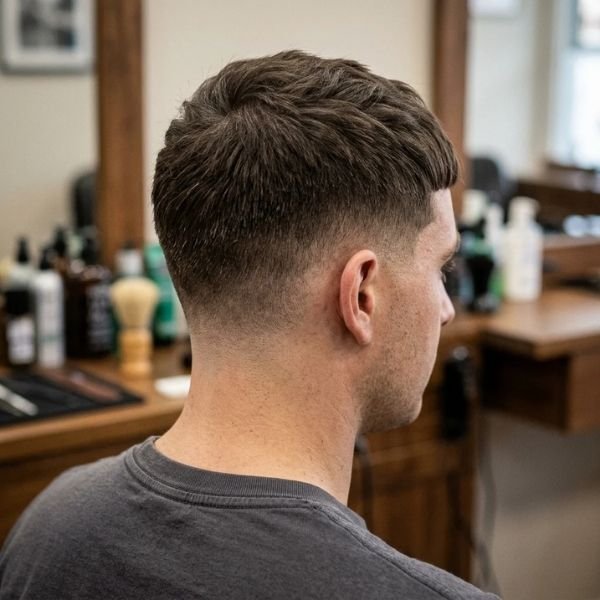
A low fade starts just above the ear and follows the neckline. It is the subtlest option and grows out gracefully.
Pair it with a half inch fringe for a clean, everyday look.
6. Caesar with a Mid Skin Fade
The fade begins around the temple and drops to bare skin at the bottom, usually finished with a foil shaver.
The contrast makes the fringe stand out. Plan a refresh every two to three weeks.
7. High Fade Caesar
A high fade starts near the crown line and creates the boldest contrast. It makes the top look fuller and suits strong jawlines.
It shows regrowth fast, so it needs the most frequent visits of any fade.
8. Caesar with a Drop Fade
The fade line curves down behind the ear instead of running straight around the head. This follows the skull shape and adds a modern edge.
It works well on rounder heads and thicker hair.
9. Caesar with a Taper and Hard Line-Up
A taper keeps some length on the sides while a trimmer sharpens the hairline across the forehead and temples.
The hard line-up frames the fringe and is a good fit for men who like a precise finish.
The Caesar on Coily and Wavy Hair
Hair texture changes how a Caesar behaves. Coils shrink and waves bend, so the cut needs small adjustments.
10. Caesar with 360 Waves
A 360 wave pattern circles the whole head. The top is kept short so the waves stay visible, and the sides are brushed in one direction.
Daily brushing, a moisturizer, and a durag at night keep the pattern defined.
11. Caesar with a Taper Fade on Coily Hair
Coily hair shrinks, so a one inch top looks shorter once dry. The barber shapes the fringe by brushing the coils forward before cutting.
A taper fade keeps the sides crisp while the top holds its shape.
12. Caesar with a Sharp Line-Up and Beard
A beard trimmed to about half an inch balances the short top. The barber blends the beard into the fade so there is no abrupt jump.
The line-up and beard edge should match in sharpness, or the face looks uneven.
13. Low Caesar on 4C Hair
4C hair has a tight coil pattern and dries out easily. A low Caesar with a number 2 or 3 top is simple to manage.
Use a leave-in moisturizer and a soft brush to keep the shape forward.
14. Wavy Caesar on 2B Hair
2B hair has loose S-shaped waves. Keep the top near an inch to an inch and a half so the waves lie forward instead of sticking out.
A light cream and air drying give a natural finish.
Caesar Cuts for Thinning Hair and Receding Hairlines
The forward fringe is why many men with hair loss choose this cut. Short, even hair hides gaps better than long hair combed over them.
15. Caesar for a Receding Hairline
The fringe falls over the temples and softens the recession. Keep it short and even, and avoid heavy product that clumps the hair.
A taper on the sides looks more natural than a skin fade here.
16. Caesar for a Thinning Crown
Cutting the top shorter reduces the contrast between hair and scalp at the crown. A number 3 guard is a common starting point.
A light texturizing powder adds visual density without weight.
17. Caesar with a Number 2 Top
A number 2 guard leaves about a quarter inch of hair. It is the lowest maintenance option and works well as hair loss progresses.
The fringe is barely visible, so a clean line-up gives the cut its structure.
Textured and Modern Caesar Variations
These versions add movement while keeping the short, forward shape that defines a Caesar.
18. Lightly Textured Caesar
The barber point cuts the top to break up the flat finish. A pea-sized amount of matte clay gives separation.
This sits between a classic Caesar and a textured crop.
19. Caesar with a Curved Fringe
The fringe follows a gentle arc instead of a straight line. This softens the look and flatters square jaws.
Ask for a curve that rises slightly at the temples.
20. Messy Caesar for Thick Hair
Thick hair can look bulky when cut short. The barber removes weight with thinning shears and leaves the top about an inch and a half.
Tousle it forward with paste for a lived-in finish.
Caesar vs French Crop vs Textured Crop
These three cuts share a short back and sides with hair brushed forward, which is why they get mixed up. The main difference is the fringe. As Ready Sleek explains, a Caesar has a shorter, blunter fringe, while the contrast in length between top and sides is usually greater on a French crop. Barber Moots, quoted by PureWow, adds that a Caesar shows no texture and has a sharper, deeper hairline, while a French crop shows texture and a longer fringe.
The table below compares typical features. Barbers use the names loosely, so treat the numbers as a guide.
| Feature | Caesar | French Crop | Textured Crop |
| Fringe | Short, blunt, straight | Longer, often feathered | Broken or undefined |
| Top finish | Flat and even | Soft, light texture | Piece-y and layered |
| Hairline | Straight and sharp | Straight but softer | Natural and uneven |
| Sides | Scissor, taper, or fade | Often faded, higher contrast | Taper or fade |
| Styling effort | Almost none | Low | Low to medium |
In short, a Caesar is the cleanest and shortest of the three. A French crop adds length and softness, and a textured crop drops the defined fringe altogether. There is no fixed point where one becomes the other, which Hairfinder also notes, since the bang length is the key separator.
Clipper Guard Numbers for a Caesar
Guard numbers help you describe length precisely. Standard guards measure as follows:
• Number 1: one eighth of an inch (3 mm), used for fade bottoms
• Number 2: one quarter inch (6 mm), a very short Caesar top
• Number 3: three eighths of an inch (10 mm), a common short top
• Number 4: half an inch (13 mm), a classic Caesar top
• Number 6: three quarters of an inch (19 mm), a longer fringe
Most Caesars use a number 3 to 6 on top. Sides sit at a number 1 to 3, or fade to the skin.
How to Choose a Caesar for Your Face Shape
Face shape guides fringe length and side contrast. Use these pairings as a starting point:
• Oval: most versions work, so choose by hair type.
• Round: a high fade and a short fringe add height and lengthen the face.
• Square: a curved or lightly textured fringe softens the jaw.
• Long or oblong: a slightly longer fringe shortens the forehead. Skip very high fades.
• Heart: a low taper with a medium fringe balances a wider forehead.
Hair density and cowlicks matter as much as face shape, so ask your barber to check both.
What to Tell Your Barber
Clear instructions prevent most bad cuts. Follow this order:
1. Show a photo and say “Caesar cut” so you share the same name for it.
2. State the top length with a guard number or inches.
3. Describe the sides: scissor cut, taper, or fade, and where it starts.
4. Specify the fringe: straight across, curved, and how far down the forehead.
5. Choose the neckline and line-up: rounded, blocked, or sharp.
6. Mention any cowlick, thinning, or hair texture concerns.
A sample script: “A Caesar with a number 4 on top, straight fringe, low taper on the sides, and a natural neckline.”
Maintenance and Styling
A Caesar is one of the easiest cuts to keep up. Most of the work is regular trims.
• Book a trim every three to four weeks, or every two to three weeks with a skin fade.
• Comb damp hair forward before it dries to train the fringe.
• Use a pea-sized amount of matte clay or paste, not heavy gel.
• Wash two to three times a week so the scalp stays healthy.
Short hair shows the scalp, so use sunscreen on exposed skin and treat dryness early.
Where the Caesar Cut Gets Its Name
The name comes from Julius Caesar, the Roman general and statesman. Roman busts show short hair brushed forward over the brow, and the Roman historian Suetonius wrote that Caesar combed his hair forward from the crown to hide his baldness. You can read more about him at Britannica.
The style returned to popularity in the 1990s, when television actors helped make the short forward fringe a mainstream choice. Today it remains a staple in barber shops worldwide.
When a Caesar Is Not the Right Cut
A Caesar is not for everyone. Think twice if any of these apply:
• Your front hairline has a strong cowlick that pushes hair upward.
• You have advanced hair loss across the whole top, since there is little to brush forward.
• You want length you can tie back or part to one side.
• You dislike a visible scalp, scars, or skin blemishes on the forehead.
In those cases a textured crop or a slightly longer cut gives more flexibility.
FAQ
What Is a Caesar Haircut?
A Caesar haircut is a short cut with an even top and a straight, blunt fringe brushed forward. The sides are scissor cut, tapered, or faded.
What Is the Difference Between a Caesar and a French Crop?
A Caesar has a shorter, blunter fringe and a flatter top. A French crop has a longer, more textured fringe.
Is a Caesar Haircut Good for a Receding Hairline?
Yes. The forward fringe covers the temples and the short length makes recession less obvious.
How Often Do You Need to Cut a Caesar?
Every three to four weeks for most versions, and every two to three weeks if you wear a skin fade.
Can You Get a Caesar with Curly Hair?
Yes. Curly and coily hair suits a Caesar when the top is kept short and brushed forward. Moisturize to avoid frizz.
How Do I Style a Caesar Haircut?
Comb damp hair forward, dry it, then apply a pea-sized amount of matte paste to set the fringe.
Conclusion
The Caesar Haircut works because it is simple, sharp, and forgiving. With 20 variations, there is a version for straight, wavy, coily, thinning, and receding hair.
Pick your fade or taper, choose a top length with a guard number, and decide how blunt or textured you want the fringe. Save a photo, use the barber script above, and keep a regular trim schedule. Tell us in the comments which Caesar you are trying next, and share this guide with someone who needs a new cut.

