


Yes, pixie cuts for heart-shaped faces are some of the most flattering short hairstyles you can choose. A heart face has a wider forehead and cheekbones with a narrower chin, and a well-planned pixie balances those proportions.
The trick is where the hair sits. Soft fringe covers the upper face, and fullness near the jaw or ear adds weight to the lower half. This guide shares 25 pixie cuts grouped by how they work, plus the reasons they flatter, exact words to use with your stylist, daily styling tips, and honest cases where a pixie may not fit. Every pick below comes with the hair type it suits best.
Pixies Led by a Softening Fringe
Fringe is the most direct fix for a broad forehead. These seven cuts use bangs to shorten the brow line and pull attention to the eyes.
1. Side-Swept Fringe Pixie

A long fringe slides diagonally from a deep part across the forehead. The angle breaks up the width of the brow and leads the eye toward the cheekbone. Keep the sides short and neat so the shape stays crisp.
Best for: straight to wavy hair with medium density.
2. Wispy Full Fringe Pixie

Thin, feathered bangs skim the brows and stay see-through at the ends. The forehead feels covered without looking heavy. Stylists often pick this look for heart faces because it softens the top without hiding it.
Best for: fine to medium hair.
3. Curtain Fringe Pixie

Center-parted bangs fall to each side and end near the cheekbones. They frame the eyes and add width where the face starts to narrow. Ask for point-cut ends so the pieces bend inward.
Best for: wavy hair, or anyone growing out bangs.
4. Baby Fringe Pixie

A short, textured fringe sits well above the brow. It is bold, but the choppy ends keep it from looking harsh. This one works when you want to show off the forehead instead of covering it.
Best for: strong features and a low-fuss routine.
5. Blended Fringe Pixie for Fine Hair

The fringe melts into the sides and crown with no hard line. Blending avoids a heavy chunk of hair on thin strands and keeps volume even across the head.
Best for: fine, straight hair that needs the look of body.
6. Honey-Highlighted Fringe Pixie

Warm honey highlights around the fringe add dimension. Lighter pieces near the face brighten the upper area, while a deeper root keeps the cut grounded and natural.
Best for: light to medium brown hair and warm skin tones.
7. Grown-Out Fringe Pixie

A fringe left to grow becomes a long, side-leaning sweep. It is the most forgiving fringe choice because it softens the brow without weekly trims.
Best for: anyone between cuts or nervous about commitment.
Textured Pixies with Fullness Near the Jaw
A heart face narrows at the chin, so extra texture around the ears, jaw line, and nape fills in the lower half. These six cuts do exactly that.
8. Jaw-Length Piece Pixie

A few longer pieces near the ears end at jaw level. They add visual width at the point where the face tapers. Ask your stylist to point cut them so they curl slightly forward.
Best for: straight and wavy hair.
9. Tousled Textured Pixie

Choppy layers styled with a light paste create movement all over the head. The messy shape spreads attention evenly instead of pulling it upward.
Best for: medium thickness and wash-and-go mornings.
10. Curly Pixie with Low Volume

Curls stay close at the crown, with a little more length at the sides. Keeping the top low stops the head from looking top heavy, while side curls add softness near the cheeks.
Best for: 3A to 3C curl patterns.
11. Nape-Length Textured Pixie

Hair at the back rests against the nape while the top stays textured and short. That extra weight at the neckline balances a narrow chin from the side and from behind.
Best for: thick hair that grows quickly.
12. Cool-Brunette Layered Pixie

Ashy brown shades and soft layers create depth. Cool tones add shine, and layering keeps the sides from lying flat. A blue-toned shampoo helps the color stay cool between salon visits.
Best for: cool or olive skin tones.
13. Round-Layered Pixie

Layers cut in a rounded shape build a soft, domed outline. The curve offsets a pointed chin and makes the whole silhouette feel gentler.
Best for: straight, thick hair.
Longer Pixies with Chin-Length Framing
Longer pixies keep short sides and a short back, but the front pieces reach the chin. That adds width exactly where a heart face needs it.
14. Chin-Length Front Pixie

Front sections end right at the chin, so the narrowest part of the face gets wrapped in soft hair. The back and sides stay short and tidy.
Best for: a first step away from long hair.
15. Pixie-Bob Hybrid

This cut pairs a short crown with bob-length sides. The sides land near the jaw to add fullness, and the crown stays short for lift. Lines are defined, so it looks polished.
Best for: straight hair and anyone growing out a bob.
16. Deep-Part Longer Pixie

A deep side part throws longer hair across the forehead and visually shortens it. The pieces at the part stay long enough to cover one side of the brow.
Best for: straight or slightly wavy hair.
17. Wavy Longer Pixie

Loose waves add width at the jaw and make angles disappear. A diffuser or a sea salt spray gives the pattern shape without stiffness.
Best for: natural 2A to 2C waves.
18. Sliced Long Pixie
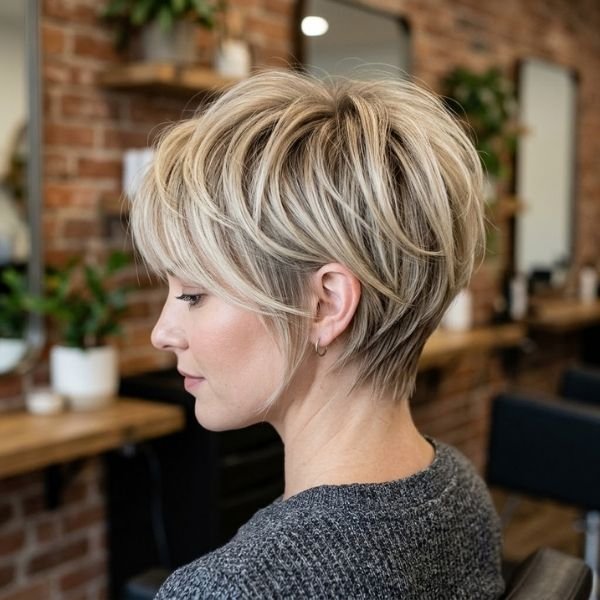
Slicing is a razor or shear technique that removes weight and leaves thin, feathery ends. Sliced front layers sweep across the cheeks and create soft edges around the face.
Best for: thick or coarse hair that feels heavy.
19. Salon-Script Grown-Out Pixie

This is a grown-out pixie planned with your stylist, so every stage of growth looks intentional. Keep the fringe long, tidy the nape every few weeks, and let the sides gain length slowly.
Best for: people who want a gentle path from pixie to bob.
Cropped and Bold Pixies That Still Flatter
Short does not mean unflattering. These six cuts go bolder, but each one still keeps balance around the forehead and jaw.
20. Classic Short Crop with Fringe
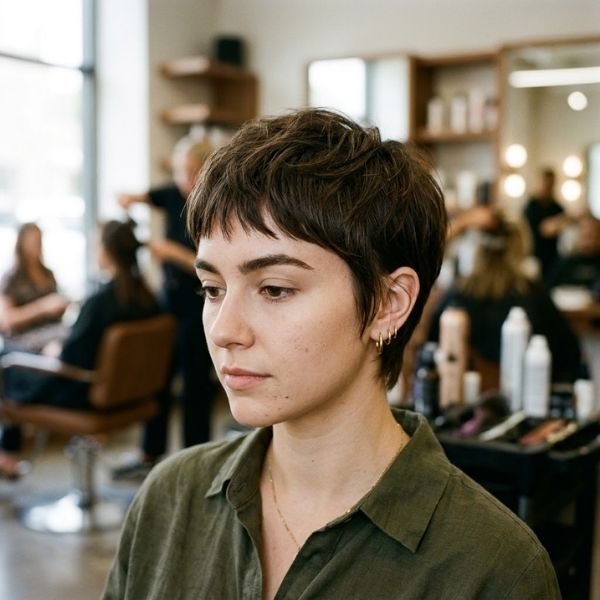
Short all over with a soft fringe, this is the traditional pixie. The fringe handles the forehead, and the short sides show off cheekbones.
Best for: a timeless, easy cut on most hair types.
21. Copper Cropped Pixie
Warm copper brightens the face and draws the eye to the center instead of the edges. The cropped shape keeps the look sharp and playful.
Best for: fair to medium skin tones that love color.
22. Undercut Pixie with Long Top
Very short sides sit under a longer top that sweeps forward. Keep the undercut low so the jaw area does not lose all its fullness.
Best for: bold dressers who like contrast.
23. Asymmetric Bold Pixie
One side runs longer than the other. The longer side reaches the cheekbone or jaw and adds width, while the diagonal line leads the eye downward.
Best for: straight hair and confident stylers.
24. Fine-Hair Cropped Pixie
Short, textured ends keep thin hair looking dense. A cropped length avoids the see-through look fine hair gets when it is longer. A light volumizing mousse at the roots helps.
Best for: fine or thinning hair that needs structure.
25. Bixie for a Heart Face
A bixie blends a bob and a pixie, with choppy layers and a little extra length at the front and nape. It is looser than the pixie-bob hybrid and feels shaggier, which softens a sharp chin.
Best for: first-timers who want a safe bridge to short hair.
How a Pixie Balances a Heart Face Shape
A heart face is widest across the forehead and cheekbones and narrowest at the chin. The goal of any cut is to even out that top-heavy line. A pixie does this by controlling where hair adds width.
Stylists quoted by PureWow often point to wispy or round bangs on a pixie for this face shape. Another stylist told Coveteur, a fashion and beauty site, that heart and oval faces can carry almost any pixie. Actress Michelle Williams, known for films like Manchester by the Sea, and actress Taraji P. Henson, known for the TV drama Empire, are often cited as heart-face examples who wear short cuts well.
| Face trait | What the pixie should do |
| Wide forehead | Use a fringe or deep part to shorten the brow line. |
| High, prominent cheekbones | Leave side pieces that frame the cheek instead of hiding it. |
| Narrow chin | Add fullness near the jaw, ears, or nape. |
| Pointed chin | Keep volume at the crown low so the face does not look longer. |
What to Tell Your Stylist
Clear words beat a vague “make it short.” Bring two or three photos and use these requests as a script:
1. “I have a heart-shaped face with a wide forehead, so I want a soft fringe.”
2. “Please leave some length near my ears and jaw for fullness.”
3. “Keep the crown low and textured, not tall.”
4. “Point cut the ends so nothing looks blunt.”
5. “Tell me how short the nape should go and how often I need a trim.”
6. “Show me how to style it at home before I leave.”
A good stylist will also check your hairline, cowlicks, and hair density before cutting. If they skip that step, ask them to look at it. Cowlicks at the front can change how a fringe sits, so it pays to plan around them.
Maintenance and Styling
Pixies look effortless but need steady care. Plan on a trim every four to six weeks to keep edges clean and the fringe at the right length.
• Use light products. A pea-sized amount of paste, clay, or cream is enough. Heavy gel flattens hair and shows the forehead more.
• Style the fringe first. Blow dry it in the direction you want while it is damp, then finish the rest.
• Add lift away from the crown. Use a round brush or fingers to push hair sideways near the temples and jaw.
• Protect from heat. Short hair is easy to over style, so use a heat protectant and a low setting.
• Refresh color on schedule. Copper, honey, and cool brunette shades fade, so book a gloss every few weeks.
For fine hair, use a volumizing mousse at the roots. For curls, apply a leave-in cream and scrunch. For thick hair, ask for internal layers so the cut does not puff out at the sides.
When a Pixie Is Not the Right Choice for a Heart Face
A pixie suits most heart faces, but it is not for everyone. Think twice in these situations:
• You strongly dislike showing your forehead, ears, or neck and do not want any fringe.
• You want a ponytail or updo every day, since a pixie cannot be tied back.
• You will not visit a salon every month or so for upkeep.
• A strong front cowlick or a very low hairline fights the fringe direction.
• You are making the cut on impulse after a stressful week and have not tried a shorter length first.
If you are unsure, step down gradually. Try a chin-length bob first, then a bixie, then a full pixie. Many salons also offer a consultation before any cutting starts.
FAQ
Do pixie Cuts for Heart-Shaped Faces?
Yes. A pixie can balance a wide forehead and narrow chin when it includes a soft fringe and some fullness near the jaw.
What Kind of Fringe Is Best for a Heart Face with a Pixie?
Side-swept, wispy, and curtain fringes work best because they soften the forehead without adding heavy width.
Should a Heart Face Keep a Pixie Longer or Shorter?
Slightly longer pixies with chin-length front pieces are the safest, though cropped pixies also work with a fringe.
What Should a Heart-Shaped Face Avoid with a Pixie?
Avoid tall crown volume, a stiff slicked-back look, and sides cut too close if you have a narrow chin.
Is a Pixie Good for a Heart Face with Fine Hair?
Yes. Blended or cropped textured pixies make fine hair look fuller, especially with a light volumizing product.
How Often Does a Heart-Face Pixie Need a Trim?
Plan on a trim every four to six weeks to keep the fringe, nape, and sides in shape.
Conclusion
The best pixie cuts for heart-shaped faces share one idea: soften the top and add weight near the bottom. Start with a fringe that suits your hair, choose the length that matches your comfort level, and bring clear words and photos to your stylist.
Pick one or two favorites from the 25 above and show them at your next appointment. Which style are you leaning toward? Share this guide with a friend who is thinking about a big chop, and tell us in the comments how your cut turned out.

