
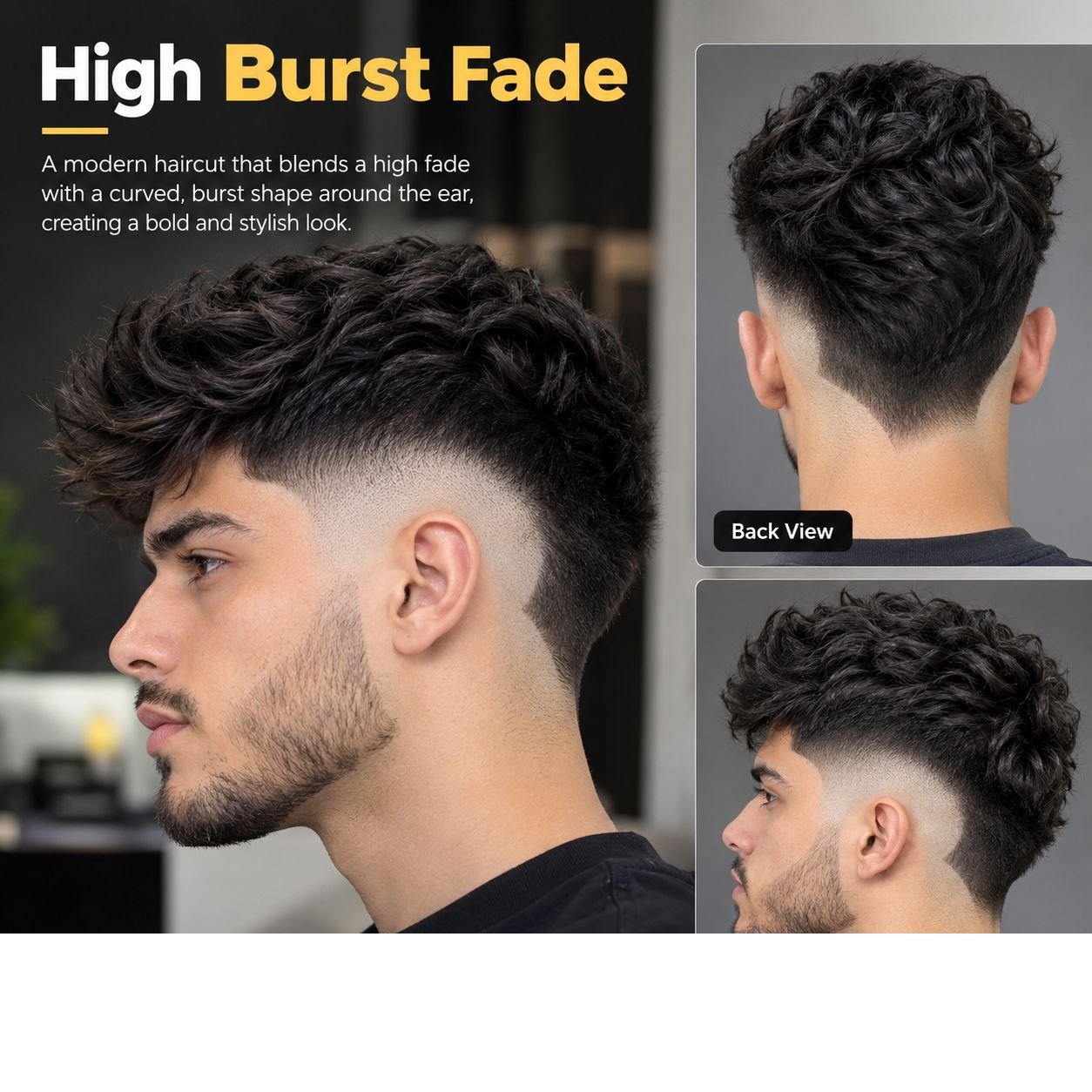

A high burst fade is a stylish and modern haircut that gives the sides a clean, sharp look. It has a curved fade around the ears and keeps more hair length on top. This haircut can work with many styles, including curly hair, waves, textured hair, and a mohawk. Its fresh shape makes it a popular choice for people who want a bold yet neat appearance.
Looking for a haircut that feels fresh without looking too complicated? This style gives you many styling options while keeping the sides neat. You can choose a short top, long top, or natural texture. The right fade height, hair texture, and barber technique can completely change the final look and help you find a style that matches you.
This haircut is easy to customize for different hair types and personal preferences. You can choose a skin fade, soft blend, or sharp finish. Good maintenance, regular trims, and simple hair products can help keep the shape clean and fresh.
What Is a High Burst Fade?
A high burst fade is a modern haircut that creates a curved fade around the ears while taking the fade higher on the sides of the head. Instead of fading straight around the entire head, this style follows the natural shape of the ear. The hair becomes shorter as it moves toward the ear and gradually becomes longer above and around the faded area. This gives the haircut a clean but bold appearance.
The main feature is the curved shape. A traditional fade usually creates a more even transition around the sides, while a burst fade focuses on the area around the ears. The higher placement makes the contrast more noticeable. It can be combined with different hairstyles, including a textured top, curly hair, waves, mohawk, quiff, mullet, and short crop.
This haircut is also flexible because the top does not have to follow one specific length. You can keep the hair short for easy styling or leave it longer for more volume and movement. The sides can also be finished with a skin fade, zero fade, or clipper fade, depending on how sharp you want the result.
What Does a High Burst Fade Look Like?
A high burst fade has a rounded appearance around the ear. From the side, you can clearly see the hair becoming shorter as it moves toward the ear. The fade then blends upward into longer hair, creating a smooth transition.
The fade usually reaches higher on the side than a low or medium burst fade. This gives the haircut a stronger contrast. The top can remain full, textured, curly, wavy, or styled upward.
The back is another important part of the design. Some people keep the back relatively short, while others leave extra length for a mohawk or modern mullet. Because the burst fade mainly focuses on the area around the ears, it provides more freedom with the back than some traditional fade styles.
The final appearance depends on several details, including:
- Fade height
- Hair length on top
- Hair texture
- Clipper length
- Shape around the ears
- Neckline style
- Amount of contrast
- Styling method
A clean blend is especially important. If the transition contains harsh lines, the haircut may look unfinished. A skilled barber gradually blends each section so the short and long areas connect naturally.
High Burst Fade vs Burst Fade: What Is the Difference?
The terms are closely related because a high burst fade is simply a higher version of the general burst fade design. A burst fade describes the curved fading pattern around the ear, while “high” describes where that fade reaches on the side of the head.
A regular burst fade can sit at different heights. A lower version keeps more hair toward the upper side, while a higher version removes more hair around the temple and upper side area.
| Feature | Regular Burst Fade | High Burst Fade |
| Main shape | Curved around the ear | Curved around the ear |
| Fade position | Can vary | Positioned higher |
| Side contrast | Moderate to strong | Usually stronger |
| Top length | Flexible | Flexible |
| Back length | Flexible | Often kept longer for certain styles |
| Styling options | Many | Many |
The important difference is therefore the fade placement, not the basic curved design. Both styles can work with different hair textures and top hairstyles.
If you want a softer appearance, you can ask for a lower or more gradual burst. If you want more visible contrast, the barber can take the fade higher and use a shorter clipper length.
How Is a High Burst Fade Done?
Creating a high burst fade requires careful blending around the ear and sides. The barber normally works through several stages instead of removing all the side hair at once. This gradual approach helps create a smooth transition.
Starting With the Hairline
The barber first looks at the natural hairline, sideburns, temples, and shape of the head. The starting point helps determine how the fade will connect with the rest of the haircut.
The barber may create an initial guideline around the ear. This guideline establishes the basic shape of the burst. It needs to follow the natural curve rather than forming a straight line.
The hair above the guideline is kept longer so there is enough length for blending. At this stage, communication is important because the exact height can be adjusted according to your preference.
Creating the High Fade
Once the basic shape is established, the barber gradually removes more hair from the sides. The fade is taken higher than a traditional low or mid burst fade.
Different clipper guards can be used to create several levels of length. The shortest section sits near the bottom of the fade, while longer guards are used as the barber moves upward.
The goal is not simply to make the sides short. The goal is to create a gradual fade transition where each length connects smoothly with the next.
Blending Around the Ears
Blending around the ears is one of the most important parts of the haircut. The barber carefully follows the rounded shape of the ear while removing excess hair.
The curved section should look balanced from the side and back. Clippers, trimmers, and sometimes scissors may be used to remove small areas and clean the edges.
The barber also needs to avoid making the curve too wide or too narrow. Its size can change the overall appearance of the haircut.
Finishing the Neckline
The neckline completes the haircut and gives the back a polished appearance. Depending on your preference, the barber can use a natural neckline, rounded finish, or sharper outline.
The neckline should match the rest of the haircut rather than looking disconnected. Extra hair around the neck and sideburns is cleaned up, and the barber checks the haircut from several angles.
High Burst Fade Haircut Styles
One of the biggest advantages of this haircut is the number of styles you can create with it. The fade provides a clean foundation while the top determines the overall character of the hairstyle.
High Burst Fade With Textured Top
A textured top adds movement and dimension. Instead of keeping every strand at the same length, the barber creates different lengths that give the hair a natural, messy appearance.
This option is useful for people who want a modern hairstyle without spending too much time styling it. A small amount of matte clay, styling paste, or texture powder can help separate the hair.
High Burst Fade With Curly Hair
Curly hair creates a strong contrast with short faded sides. The curls remain visible on top while the area around the ears looks clean and controlled.
The barber should consider curl pattern, shrinkage, density, and natural volume before cutting the top. Keeping enough length can help the curls maintain their shape after drying.
High Burst Fade With Waves
Waves can give the haircut a smooth and textured appearance. The fade removes unnecessary bulk from the sides while the top remains long enough to show the natural wave pattern.
A wave brush and suitable hair moisturizer can help maintain the texture. Regular trimming around the sides keeps the overall shape defined.
High Burst Fade With Mohawk
A mohawk is a bold combination because the sides are heavily reduced while the center section remains longer. The burst shape naturally supports this design.
The central strip can be kept short, medium, or long. It can also be styled upward for extra height or left naturally textured.
High Burst Fade With Quiff
A quiff adds volume at the front while keeping the sides clean. The longer top can be brushed upward and slightly backward.
A blow dryer and lightweight styling product can help create volume. This combination can look polished while still maintaining a modern fade.
High Burst Fade With Long Hair
Longer hair on top provides more styling freedom. You can create a messy finish, slicked-back style, textured layers, or a longer fringe.
The contrast between long hair and faded sides can be strong, so regular maintenance is useful if you want the haircut to remain sharp.
High Burst Fade With Short Hair
Short hair makes the haircut easier to maintain. A short textured crop, fringe, or simple layered top can work well.
This option is useful if you prefer a practical hairstyle that does not require much daily styling. The fade remains the main feature of the haircut.
High Burst Fade for Different Hair Types
Hair texture plays an important role in deciding the length and styling method. The same fade can look completely different depending on whether the hair is straight, wavy, curly, thick, or fine.
High Burst Fade for Straight Hair
Straight hair gives you plenty of options. You can choose a crop, quiff, fringe, messy top, or slicked-back style.
Because straight hair usually falls naturally, the barber can focus on creating a clean connection between the top and faded sides. A matte styling product can add texture without creating too much shine.
High Burst Fade for Wavy Hair
Wavy hair naturally creates movement and volume. Instead of cutting away the texture, it is often better to preserve enough length for the waves to remain visible.
A lightweight cream or styling mousse can help define the waves. Avoid using too much heavy product because it may make the hair appear flat.
High Burst Fade for Curly Hair
Curly hair can make the contrast between the top and sides especially noticeable. The curls provide natural volume while the fade creates a cleaner outline.
The haircut should account for curl shrinkage. Hair can appear considerably shorter after it dries, so the desired final length should be discussed before cutting.
High Burst Fade for Thick Hair
Thick hair can benefit from the removal of extra bulk around the sides. The top can remain full while the fade keeps the area around the ears controlled.
A barber may use texturing techniques to make thick hair easier to style. The amount of thinning should be controlled so the hair does not lose too much natural volume.
High Burst Fade for Fine Hair
Fine hair needs a slightly different approach. Removing too much hair from the top can make it look thinner.Keeping enough length can help create fullness. Textured crops, short quiffs, and slightly messy styles can also make fine hair look more dimensional.
How to Ask Your Barber for a High Burst Fade
Clear communication can make a major difference. Instead of only saying the haircut name, explain exactly how you want the sides, top, back, and neckline.
Tell your barber:
- You want a high burst fade around the ears.
- How short you want the faded area.
- How high you want the fade to rise.
- How much length you want on top.
- Whether you want to keep the back long.
- Whether you prefer a natural or sharp neckline.
- Whether you want texture, curls, waves, or volume.
Showing a reference photo is also helpful. A side-view image can show the barber the height and curve you prefer, while a back-view photo can explain how you want the fade to connect with the neckline.If you are unsure about the exact clipper length, ask the barber to recommend one based on your hair density and desired level of contrast.
How to Choose the Right High Burst Fade
Choosing the right version depends on your hair type, preferred hairstyle, maintenance routine, and desired level of contrast.
Think about the following points before your appointment:
- Choose your fade height: A higher fade creates more visible contrast.
- Decide the top length: Short hair is easier to maintain, while longer hair offers more styling options.
- Consider your texture: Curly and wavy hair may need more length to show their natural pattern.
- Think about maintenance: Very short fades may require more frequent touch-ups.
- Match your lifestyle: Choose a style that fits your daily routine and styling time.
- Consider the back: Keeping extra length can support mohawks and mullet-inspired styles.
Your preferred appearance should guide the final choice. A good barber can adjust the fade height, blending, and top length to create a balanced result.
How to Maintain a High Burst Fade
Maintenance is important because the clean contrast of the haircut becomes less defined as the hair grows. The sides usually need more attention than the top.Wash your hair according to your hair type and use a suitable conditioner when needed. If you have curly or wavy hair, keeping the hair moisturized can help preserve its natural texture.
For styling, use only enough product to achieve the desired finish. Too much wax, clay, or gel can create buildup and make the hair look heavy.The faded area should not normally require daily styling. However, keeping the edges around the ears, sideburns, and neckline clean can make the haircut look fresher.
Avoid cutting the curved section yourself unless you have experience with clippers. The shape around the ear is difficult to recreate evenly, and a small mistake can affect both sides.
How Often Should You Get a High Burst Fade?
The right haircut schedule depends on how quickly your hair grows and how sharp you want the fade to remain.People who prefer a very clean and defined appearance may choose a barber visit every two to three weeks. Others may wait three to four weeks and allow the fade to grow naturally.
A skin-level fade can show new growth more quickly because the difference between the shortest and longer hair is more visible. A slightly longer guarded fade can look acceptable for a longer period.Your top length also affects maintenance. Longer hair may continue to look good as it grows, while a short crop can change shape more quickly.
If you have a busy routine, discuss a lower-maintenance version with your barber. The goal is to choose a schedule that keeps the haircut looking intentional without requiring unnecessary appointments.
High Burst Fade vs Other Fade Haircuts
Fade names can sometimes be confusing because several styles use similar techniques. The main differences usually involve fade height, direction, and the area where the shortest hair is concentrated.
High Burst Fade vs Mid Fade
A mid fade generally begins around the middle area of the sides and creates a more traditional transition around the head. A high burst fade focuses on the ear area and rises higher along the side.
The mid fade can provide a more even side profile, while the burst design has a distinctive curved shape.
High Burst Fade vs Low Fade
A low fade begins closer to the lower sides and hairline. It leaves more hair toward the upper sides.
A high burst design removes more hair higher around the ear and creates stronger separation between the top and sides.
High Burst Fade vs Skin Fade
A skin fade refers to how short the hair becomes, while a burst fade refers mainly to the shape and location of the fade.
Therefore, you can have a burst fade that reaches the skin. This creates a very sharp appearance because the hair around the lowest section is reduced almost completely.
High Burst Fade vs Taper Fade
A taper gradually reduces hair around specific areas such as the sideburns and neckline. It usually leaves more hair on the sides.
A burst fade is more noticeable because it creates a larger curved faded section around the ear. The two styles therefore create different levels of contrast.
Pros and Cons of a High Burst Fade
Before choosing this haircut, it helps to understand both its benefits and possible drawbacks.
Pros
- Creates a strong and modern appearance.
- Works with straight, wavy, curly, thick, and fine hair.
- Offers many top styling options.
- Can be paired with mohawks and mullets.
- Creates a clean area around the ears.
- Can be customized with different fade lengths.
- Works with both short and longer hair.
Cons
- A high fade can create a bold contrast.
- Very short versions may require frequent touch-ups.
- The curved shape needs careful barbering.
- Uneven blending can be easy to notice.
- Longer tops may require more styling time.
- Cutting the fade too high can change the intended hairstyle.
Overall, the haircut provides plenty of room for customization. The key is to choose a fade height and top length that work together. Clear communication with your barber, a suitable hair texture plan, and regular maintenance can help you keep the finished style clean and balanced.
Conclusion
A high burst fade is a modern haircut that offers a clean and stylish appearance without limiting your styling choices. Its curved fade around the ears works well with curly hair, waves, textured tops, mohawks, and both short and long hairstyles. By choosing the right fade height, top length, and finish, you can create a look that matches your hair type and personal style.
Keeping this haircut fresh mainly requires regular trims, simple hair care, and proper styling. Talk with your barber about the fade height, neckline, and amount of hair you want to keep. With the right maintenance and a suitable style, this haircut can give you a sharp, confident, and easy-to-manage appearance.

